
In 2025 and 2026, our team ran public-facing AI Mode usability studies with more than 172 participants. We observed recurring patterns, shared beliefs, and moments of confusion as search became more conversational and summary-driven.
Our experience with search behavior and machine learning now underpins the research we run for clients. Our studies create evidence-based content that engages audiences and demonstrates thought leadership.
Competitive User Behavior Benchmarking
See how real people notice, trust, and choose between your brand and its closest competitors. Private usability studies built around your niche and competitive set. Think-aloud sessions and AI-synthesized transcripts reveal not just who is winning in search — but why.Our Focus for Clients
Our research helps agencies and brand teams working in SEO and AI Search establish a credible, evidence-based perspective.
How Our Research Helps Clients
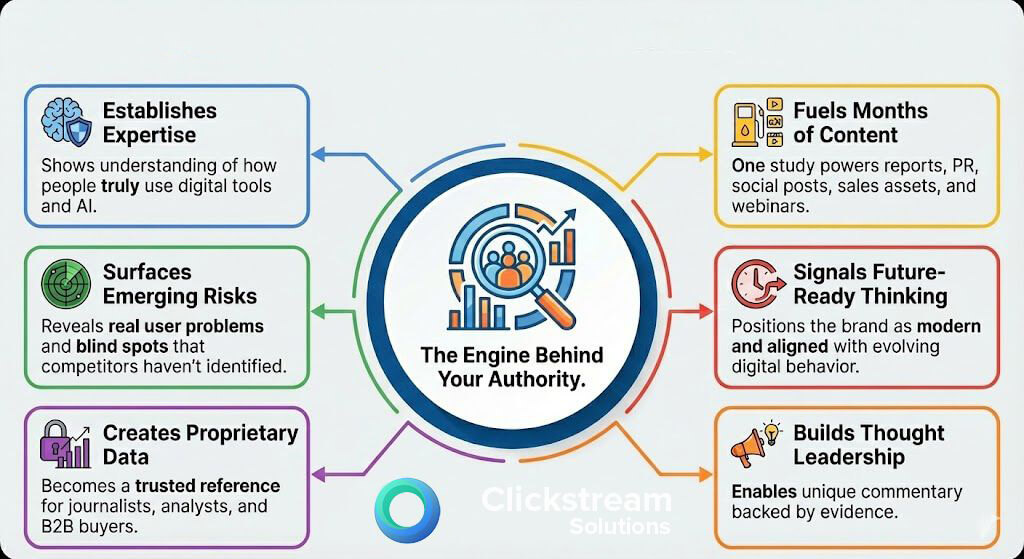
Establish expertise
Studies demonstrate your understanding of modern digital behavior, not just surface-level metrics.
Surface new opportunities
- Reveal patterns and preferences competitors miss.
- Uncover unmet needs and shifting expectations.
- Create fresh, data-backed story angles.
Build thought leadership
- Enable commentary grounded in evidence rather than recycled narratives.
Signal future-ready thinking
- Align your brand with how search and AI actually function today.
- Strengthen confidence among customers, partners, and investors.
Fuel months of content
- PR
- Reports
- Webinars
- Social posts
Usability Studies
In 2025, our team completed three large-scale usability studies of Google Search and AI Mode with more than 130 participants. We also developed a RAG-driven AI system to extract consistent patterns from complex, real-world sessions.
The AI Overviews usability study conducted for Growth Memo became Kevin Indig’s most-read post of 2025.
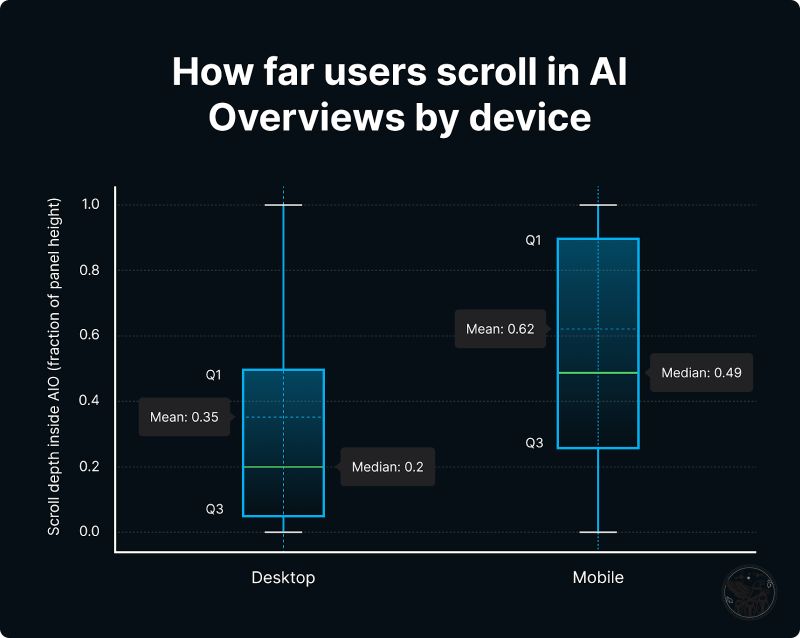
One of many insights: The first-ever usability study of Google Search in the modern SERP era. Chart via Growth Memo.
A study for your brand can show how AI-driven search reshapes discovery, trust, and decision-making in categories that matter to your customers.
From Scope to Report: How We Deliver Insights
- Define Scope: Work collaboratively with the client to align on the Ideal Customer Profile (ICP), business goals, and specific research questions.
- Design Tasks: Create realistic search tasks to surface key Search Engine Results Page (SERP) features, such as AI summaries, local packs, shopping units, and external links.
- Recruit Participants: Identify qualified participants who align with the target audience for moderated or unmoderated sessions.
- Capture Evidence: Run sessions with full screen and audio capture, collecting raw evidence like:
- Recordings and transcripts
- Queries and clicks
- Dwell time and scroll behavior
- Confidence signals
- Analyze Findings: Code every session using a consistent annotation framework to ensure findings are measurable and not anecdotal.
- Deliver Report: Draft a publishable report with findings, which typically takes about six weeks once the scope is aligned.
Sector-specific studies can surface similar winner-and-loser dynamics early. For example, in our travel research, local packs tended to benefit operators, while large travel platforms often lost attention.
Data Studies
Usability studies reveal how people behave inside modern search and AI interfaces. Data studies answer a different question: which signals consistently shape visibility and citation at scale.
Where usability research observes real users directly, data studies analyze large aggregated datasets to identify patterns that influence AI and search systems over time. These studies are especially effective for publishing defensible insights into what search engines and AI models reward.
Our data studies focus on isolating those relationships and translating them into narratives that hold up under scrutiny.
Typical inputs include
- Content and on-page structure data
- Link profiles and off-site authority signals
- Keyword patterns and topic coverage
- SERP features, citations, and visibility indicators
The studies ask
- Which signals are consistently associated with being cited or surfaced
- How strongly different signals appear to be weighted
- Where common optimization assumptions break down
- Which factors matter more in AI-mediated results than in traditional rankings
Why Data Studies Still Matter in the AI Era
AI-driven search compresses information before users interact with it. As a result, understanding eligibility and selection signals matters more than clicks alone.
The studies are particularly valuable for SaaS companies, agencies, and platforms that want to shape how SEO, GEO, and AI visibility are discussed across the industry.
Sample Data Study Idea, Signal Importance in Google AI Overviews

This study would examine how Google’s AI systems interpret content signals to determine eligibility for citations in AI Overviews. By weighting inputs such as direct-answer extractability, structured data, content freshness, and social proof, the study would highlight which signals appear to matter most.
Survey Studies
Data sources include partnerships with Surfer SEO, Ahrefs, or SEMrush.
Consumer survey studies scale the learning. They capture attitudes and decision-making signals across large samples, often 1,200 or more respondents, while keeping the output designed for publishing and reuse.
What You’ll Uncover
A strong consumer study answers a question your brand can own with evidence.
Examples include:
- How much consumers trust AI-generated answers compared to traditional results
- Which signals increase trust
- When people click out versus staying inside AI experiences
- What makes an answer feel sufficient to act on
- Which brands are remembered
- Where perceived bias influences behavior
What Consumer Survey Studies Are (and Aren’t)
To interpret these findings correctly, it helps to be clear about what this type of study is designed to do.
A consumer survey study is a structured research instrument designed to measure perspectives, attitudes, intent, and self-reported behavior. It is built around a question your brand wants to own and designed to be publishable, reusable, and evergreen.
It is not a quick poll for social engagement. It is a research-grade asset designed to withstand scrutiny.
How We Run Survey Studies
We scope the question and hypothesis, design the instrument, recruit respondents, and structure the sample to reflect the audience you care about. We apply basic rigor to prevent weak data from shaping the narrative, including screeners, attention checks, speeding detection, quota sampling where appropriate, and clear reporting on sample size and confidence intervals.
The final output is a branded research report your organization can publish and reuse across channels.